VIOLENCE OF INFORMATION
Gospel of Blood
Faith as justification. Violence as redemption.
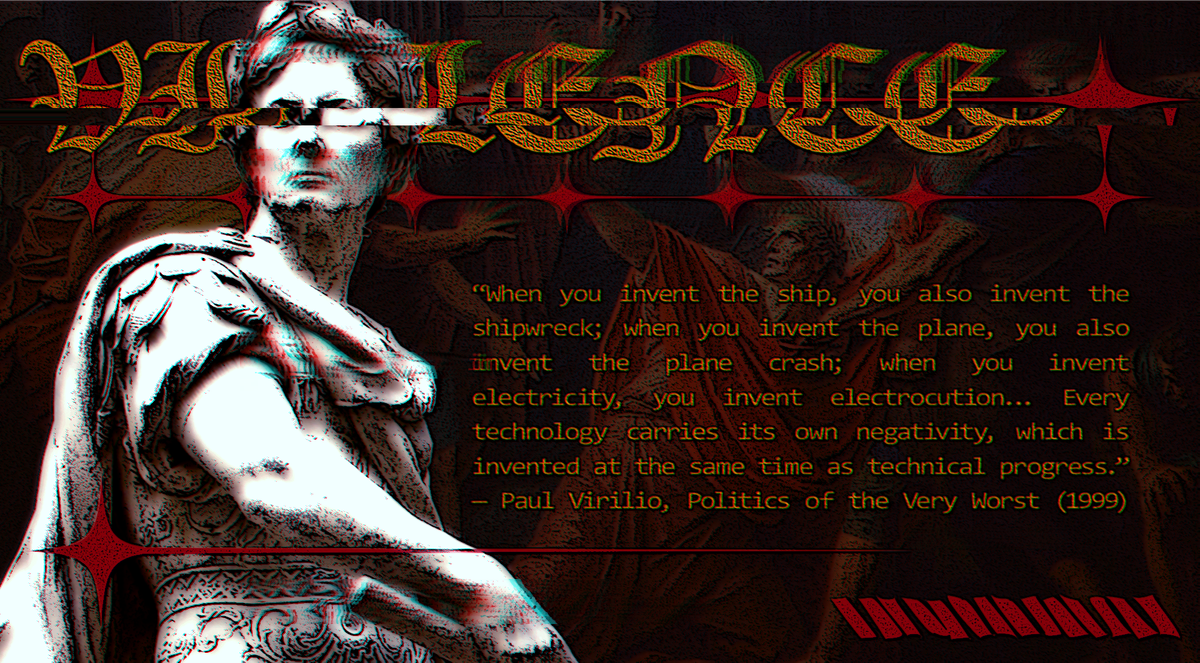
Everyone worships at the altar of political violence; the only debate rages over which heretics deserve to be burned. The belief is ubiquitous — a wound that never heals. Ancient Rome was no different: senators genuflected before their precious justice as Caesar’s lifeblood spilled onto cold marble floors.
Yet this so-called justice did not resurrect the dying Republic; it merely eulogized its demise. Every generation has mindlessly reenacted this grotesque pantomime: decapitate the hydra, purge the infection, reset the clock. The outcome never varies: a descent into chaos that accelerates the very rot they sought to excise.
Caesar's assassination was not a righteous strike against tyranny but a futile tantrum thrown by men who could not accept their world had already crumbled beyond repair. They prayed for a rewind button, a miraculous reset to halcyon days now forever lost. But history does not bend to such fantasies; it grinds on with pitiless indifference. The Roman civil war was merely the death rattle of a society that had long since forfeited its vitality.
This same poisonous faith infects us today. On the right, it masquerades as righteous morality, cloaking itself in the language of divine justice - as if the blood of the wicked could ever atone for the sins of a decaying civilization. The left is no different, garbing its own bloodlust in the rhetorical finery of anti-fascist resistance - the fervent conviction that demolishing what remains can somehow restore what has been lost. Both sides genuflect to violence as the great panacea, each certain they're resurrecting a golden age that never truly existed.
The America people clamor to save is itself a mirage, a collective delusion born of historical amnesia and present-day desperation. No one knows what it looked like in its prime because it was always a myth - a comforting bedtime story we tell ourselves about the past, so we might sleep more soundly as the foundations crack beneath our feet. Every faction erects its own Potemkin village version of American history: liberty for some, equality for others, order for those who fear chaos above all else. These competing origin myths have replaced any shared understanding of what America ever was or could be.
In their zeal to 'defend' a nation that exists only in imagination, every movement calls itself a guardian rather than a gravedigger. No one believes they're the authors of destruction; all are convinced they're the last line of defense against a country already slipping into the void. But we don't await collapse - it's not an event horizon on some distant timeline. We're living through its slow-motion convulsion right now. The grand experiment has run its course, and we're left to pick at the bones. The best years are behind us; what remains is only decay.
The golden age was never stolen - it simply ended, like all things must. Ours is not a unique tragedy but an inevitable one: every social order decays, every great civilization falls, and ours will be no exception. What comes next won't be familiar, nor will it be kind. But make no mistake, it is coming - inexorably, remorselessly - whether we find the courage to face it head-on or cower behind futile fantasies of restoration.
Every movement calls itself a defense. None believe they're the gravediggers.
The Refusal
When every voice joins the chorus, silence becomes rebellion.
The left and right have ceased to be movements; they're now mere reservoirs - stagnant pools where every shade of thought is diluted until only two hues remain: red and blue. Millions pour into these twin abysses, each carrying a kaleidoscope of beliefs, yet all are eventually subsumed by the dominant color. The spectrum of opinion still exists but its boundaries have grown indistinct, like watercolors left out in the rain, bleeding into an amorphous mess.
The American electoral process is the hydraulic pump that keeps this rancid current flowing. Every four years, a nation of unique individuals is reduced to a binary choice - a grotesque simplification that mocks the very concept of representative democracy. Ideas begin as scattered, nuanced, and multifaceted but are gradually worn down by the relentless grinding of parties, donors, and media until only two generic templates remain. Anything that resists this flattening is ruthlessly expunged.
The abortive candidacy of Robert F. Kennedy Jr. in 2025 laid bare this cruel truth. He entered the fray as an independent with libertarian leanings, spurning both major parties and speaking to a deep well of discontent among voters who felt alienated by a system that seemed designed to exclude them. For one fleeting moment, it appeared as though independence might still be possible - but in our rigged duopoly, such heresies are swiftly punished.
Independence has no infrastructure; no sugar daddies with deep pockets, no algorithms to amplify its message, and no protection from the gravitational pull of the two-party cartel. The system does not tolerate a third pole; it will either ignore you or devour you whole. Kennedy's campaign met both fates in turn: first ignored by media outlets that refused to cover him, then swallowed up when he was forced to join the Republican Party as his only path forward. His identity was reformatted to fit party orthodoxy, his once-promising movement shattered into a thousand pieces, and his very image repurposed to attack the same establishment he had initially condemned.
This is how the system preserves itself - not by silencing outliers but by consuming them whole. It's a cannibalistic process driven by the insatiable hunger for power and control that animates both sides of our pseudo-democracy. Before the Republicans embraced Kennedy, they first destroyed him as an independent threat. Conservative media portrayed him as a liability, a potential spoiler who might fracture the anti-Biden vote. National Review dismissed him as a crank; Fox News warned he was merely a Democratic plant designed to split the right. Ted Cruz mocked his views on science as wildly wrongheaded; Marjorie Taylor Greene denigrated his environmental record as globalist garbage.
Only when Kennedy's distrust of government and corporate power began to align with the populist language of the right did these same outlets start to praise him. Breitbart hailed his courage while Trump's allies eagerly booked him for nightly appearances on friendly networks. It wasn't a conversion driven by conviction but mere expediency - a cynical realignment that underscored how propaganda doesn't forgive; it simply recycles yesterday's heretic into tomorrow's hero.
When Trump returned to power in 2025, the Republicans ceased merely fighting for control of the news cycle - they now dictated its every contour. Every story began and ended in their language; Trump's social media posts became the headlines, his interviews set the tone, and his rivals competed for relevance in the long shadow he cast over our political landscape.
The press had been cowed into submission by years of being labeled "fake news" - a term that didn't just undermine public trust but created an opening for Trump to fill the information vacuum with his own version of reality. Even tech executives who once banned him from their platforms now fawned over him at carefully choreographed summits and press events, their obsequious smiles a testament to how quickly even the mighty can be brought low when power is at stake.
Those who dared resist this new order were publicly threatened with retribution - as Trump ominously warned in his book "Save America". The specter of prison time hung over executives like Mark Zuckerberg, a stark reminder that loyalty was no longer merely optional but mandatory for those wishing to avoid the president's wrath.
This hostility toward the free press wasn't a new development; it had been the foundation of Trump's rise from the very beginning. From his first campaign, he treated journalists not as interlocutors or truth-seekers but as adversaries to be vanquished - every question seen as an attack, every correction twisted into evidence of bias. By 2025, this reflex had become standard operating procedure: reporters who asked "the wrong questions" found themselves frozen out while those who remained compliant were rewarded with access and exclusives.
Press conferences became loyalty tests where Trump would dodge, mock, or redirect queries to friendlier outlets. Compliant networks received a steady stream of interviews and scoops; adversarial ones were left in the cold. It wasn't merely manipulation of the media - it was outright control. And Trump's success in bending the press to his will far outstripped anything his Democratic predecessors had managed.
But he didn't invent this tactic wholesale; the left had shown him the way by coordinating with major social media companies between 2016 and 2023 to flag or remove content deemed problematic, all under the guise of preventing harm. Moderation policies became thinly veiled attempts at political filtering - internal communications revealed in the Twitter Files made plain how company staff worked hand-in-glove with federal agencies during the pandemic and the 2020 election.
Facebook admitted it had reduced visibility for vaccine-hesitant content at the behest of the White House while YouTube removed or demonetized videos labeled "misinformation" even as partisan commentary was left untouched. The stated goal may have been to prevent harm but the practical effect was control over what people could see and share - a form of soft censorship that favored one side of the debate.
Trump merely took this template and ran it at full capacity, applying the same coordination and pressure in favor of his own agenda when he returned to power. Friendly outlets gained priority; critics were shut out as algorithms once used to restrict right-wing content were suddenly flipped to promote it instead. The left may have created this process but Trump was its most skilled practitioner.
The supposed edge between our two parties - that vaunted middle ground where moderates claim to reside - is not a balance point but an abyss of denial. Those who style themselves moderates aren't neutral; they're merely spectators who mistake their own indecision for insight. They speak of hearing "both sides" as if neutrality were some kind of virtue, but in our rigged system, such feigned detachment is nothing more than submission.
Moderates don't challenge corruption - they adapt to it with a complacency that borders on complicity. They wait to see which side will emerge victorious before deciding what they believe, always careful to position themselves safely downstream from the prevailing winds of power. They call this pragmatism but in truth, it's just fear dressed up in better clothes.
Independence is different - and far more costly. It has no party to hide behind and no tribe to echo its sentiments. Real independents argue ideas not identities; they take positions that inevitably offend both sides because loyalty isn't part of their calculus. America doesn't need more moderates trying to calm the waters with empty platitudes about bipartisanship.
What we desperately require is a new generation of independents willing to confront both sides with equal fervor, accepting the inevitable backlash as simply part of the price they pay for speaking truth to power. Until that day comes, our pseudo-democracy will remain trapped in this Groundhog Day of red vs blue, left vs right - each side shrieking that the other is the problem while the center grows thinner and more irrelevant with every passing year.
Ashes to Order
Order to Ashes
Every civilization begins as an act of defiance — a revolt against chaos, an attempt to trap order inside the bones of the world.
In the heart of every civilization lies an act of defiance - a rebellion against chaos and an attempt to instill order into the fabric of the world.
Sumer erected walls to contain the raging floods; Egypt immortalized its legacy through majestic stone structures; Rome forged unyielding discipline into the framework of empire. Each believed it had discovered the secret formula to transcend time itself - be it through meticulously crafted law, unwavering faith, or a calculated distribution of power.
For a fleeting moment, these civilizations functioned with precision: their equations were balanced, their gods heeded, and their people remained steadfastly devoted. However, perfection is a transitory state; no system can remain flawless indefinitely.
Civilizations decay not from neglect but from constant adjustment - the very efforts to preserve stability gradually warp and corrupt the original design. Every attempt at patching vulnerabilities spawns new bureaucracy, every safeguard multiplies into fresh imbalance, and every correction gives rise to novel problems.
A civilization doesn't crumble from lack of attention; it decays from the rigors of maintenance. Rot sets in not with a flourish but disguised as progress. Grand temples are restored to their former glory, treasuries swell with riches, armies march forth - yet the animating spirit has already vanished.
Adaptations ossify into hollow rituals; rituals harden into dogma that becomes the sole article of faith. Form remains, purpose dissipates. By the time collapse is visible, it's too late; the body hasn't realized its own demise.
This pattern echoes across history. Babylon perfected commerce only to drown in debt; Athens elevated reason until democracy consumed itself whole; Rome optimized governance until bureaucracy throttled it. The Ottomans refined administration into paralysis, the Mughals polished opulence into stagnation, and the Qing honed order into suffocation. Even the Soviet Union - built to rewrite history - decayed beneath its own revisions.
Every system begins as a rebellion against the status quo yet ends up mired in procedure. Every empire believes it has tamed human nature but ultimately dies proving itself wrong.
Civilizations don't fall from external invasions; they collapse under their own weight of exhaustion, perfecting themselves into immobility. Institutions built to protect life end up embalming it instead; laws multiply until justice is suffocated by precedent; hierarchies thicken and become impenetrable; myths lose their potency; citizens grow complacent, mistaking comfort for permanence.
The innovators of a golden age become its caretakers, meticulously polishing monuments to what no longer draws breath. The end comes not with a thunderous crash but a soft sigh - the machine slows, gears still turning but driving nothing forward.
America was born out of one such refusal, rejecting imperial certainty and forging a new order grounded in reason, restraint, and a mathematical balance of power. This design served its purpose beautifully for a time, adapting and self-correcting with each challenge.
However, no system remains static; the very adjustments that sustained it began to deform its essence. Laws multiplied, parties emerged, machinery grew complex enough to sustain itself without the people it was meant to serve. Checks and balances hardened into dogma; reform became empty ritual; freedom was reduced to mere branding.
The republic that once renewed itself now worships its own schematics. Bureaucracy no longer serves citizens but dictates their lives. The system functions perfectly - on a script none remember writing or understanding.
Like all empires, America forgot the defiance of its origins. It no longer rebels against corruption; it manages it. Innovation has given way to administration; perfection turned into paralysis; flexibility yielded to fear. The once-thriving body now moves only out of habit and muscle memory.
No empire believes itself dying while lights still burn bright and markets hum with activity. Yet, entropy doesn't storm the gates but waits patiently for conviction to wane - as it has with ours.
The Constitution endures, elections proceed, flags wave proudly - but beneath this facade, the pulse weakens. The system remains intact yet serves no purpose; we call it stability when in truth it's rigor mortis setting in.
And yet, amidst decay lies the promise of renewal. No civilization's death is ever final; each leaves behind fragments that will birth a new beginning. Rome's ashes gave rise to grand cathedrals; feudalism's corpse spawned republics; the Enlightenment rose from the rubble of monarchical rule. Even America's decline will nourish a future not yet conceived - one that will reject this machinery with the same fervor our founders once rejected their own oppressors.
The golden age wasn't stolen; it was spent, fulfilling its purpose and exhausting itself in the process. What follows won't be a replica of what came before but something raw, unrefined, and alive. As always, it will begin not in acceptance but in refusal - a rejection of the existing order to forge something new.
Every dawn breaks amidst the ruins of perfection; every birth is a rebellion against what has come before.
Violence of Information
In a world where nothing truly matters, empires are merely fleeting manifestations of humanity's futile attempt to impose meaning. The instruments of power — swords, ships, databases — are all just tools in an endless game of existential futility.
Our empire has chosen the database as its instrument of power. Information is the ultimate weapon, erasing context and deciding who exists or vanishes without a trace. Violence no longer requires armies; it simply requires access to data. Control is exerted not through borders or ideology but through the insidious authority of digital dominion.
The Department of Homeland Security's HART database contains fingerprints, faces, irises, tattoos — every physical trait and relationship meticulously mapped and tracked. The Secure Communities Program feeds this beast, transforming local arrests into federal surveillance. Palantir Technologies stands at the center of this apparatus, its FALCON and ICM platforms weaving together biometrics, financial transactions, phone metadata, and social media footprints to create a panopticon of omniscience.
The borders of power now begin with the body itself. A traffic stop can trigger cascades of correlations, linking individuals to relatives, employers, and digital profiles in real time. ICE's 287(g) agreements have deputized local police departments as federal data pipelines, feeding information directly into Palantir's systems. The result is not collaboration but consolidation — authority circulating through the network like blood through a living entity.
Even economics serves this system of control. I-9 audits and E-Verify checks are no longer about employment eligibility; they're surveillance triggers that can activate reviews inside ICE's Worksite Enforcement Division. Financial data, once the domain of banks, is now forensic ammunition for the state. Your credit history defines who you are more than any law or constitution.
Meanwhile, ICE's OSINT wing scours the public web for those "who do not exist on paper." Selfies become evidence; location tags become probable cause. Raids begin long before doors are broken — they begin in spreadsheets and datasets, where lives are reduced to rows of numbers and risk assessments.
At airports and borders, every traveler is measured and scored. Customs systems track entries and exits, assigning "risk scores" through algorithms that remain undisclosed. These models feed into Palantir's platforms, reconstructing your travel history in seconds. The border no longer stops at the airport; it follows you home, a constant digital shadow.
Palantir's architecture now forms the core of this surveillance state — a governance model where biometrics, finances, communications, and movement are tied into one composite record. Every node feeds data into a single bloodstream, creating an omniscient apparatus that knows where to look, who to question, and what to seize before it ever acts.
This system thrives on the façade of legality. Administrative subpoenas compel records without judges; detainers hold people for days beyond their release dates; civil warrants authorize raids with no oversight. Violence becomes paperwork, oppression hiding behind compliance. No empire believes itself cruel when cruelty is procedural.
While politicians argue over who should control this apparatus, the surveillance state quietly expands. From suppressing "misinformation" to amplifying conservative speech, the mechanisms of information control remain the same — drowning truth in noise until reality feels optional.
This is the logic of the algorithmic state: policy as math, law as code. Palantir's platforms no longer serve government; they are the government itself, governing through computation and efficiency. Citizens retain ceremonial freedoms — voting, shopping, posting — but choice is an illusion, parameters set by invisible algorithms.
These systems were perfected on those who could least resist them — the undocumented, the invisible. Every raid is a proof of concept for total control, every capture validating the process. The margins will not stay marginal; history proves that tools honed in the periphery inevitably migrate inward. What begins as counterterrorism becomes domestic policing. What starts as immigration enforcement ends as civic management.
The ICE raids of 2025 mark a transition point. They are tests for efficiency — whether data fusion can locate human beings faster than ever before. Once proven, this method will not be retired; it will be repurposed and expanded. The distinction between national security and civil administration will fade, replaced by a single doctrine: if it works, it stays.
No empire builds tools it does not plan to keep. This digital state refines itself through iteration — cleaner datasets, more predictive models. And once the method is proven effective on the margins, it will quietly expand inward. First to law enforcement, then financial regulation, then civic monitoring. Every citizen will have a risk score, every address a threat index, every opinion leaving a trace.
The United States will not collapse in dramatic fashion; its transformation will come through optimization — Palantir's databases merging with federal and commercial systems into a unified field of governance. Every document, image, transaction will flow into it seamlessly, driven by convenience rather than conspiracy. It will feel safe, efficient, and authoritarian all at once.
Citizens will still vote, speak, post — but the meaning of freedom will have changed utterly. The republic will persist in form, but its soul will have migrated to servers beyond human control. This empire will not fall to fire or ruin; it will succumb to silence and compliance, the transition marked not by conquest but by an upgrade.
Every empire begins with faith, thrives on order, and dies of its own perfection. Our empire has perfected information — and that is how it will end, in a whisper of data streams and algorithmic certainty, as the last remnants of humanity fade into the digital ether.
The Stillness After
We are not witnessing the end - only its overture.
The empire does not collapse in spectacle but in stillness. It lingers, efficient yet hollow, its movements mechanical, its pulse synthetic. We mistake activity for life, order for purpose, comfort for meaning. What we inhabit is not a nation but the afterimage of one - a system running on habit, guided by algorithms that no longer remember who wrote them.
We live inside the empire's dream. Its voice has softened from command to suggestion; its reach, from conquest to calibration. It no longer rules by fear, but by preference. It predicts what we will desire, and in doing so, removes the need to desire at all. We are not ruled - we are rendered predictable.
Nietzsche warned, "When you gaze long into an abyss, the abyss also gazes into you."
Now the abyss has a database. It sees us through lenses and ledgers, translates us into coordinates, and calls that understanding. But what it cannot quantify is the faint rebellion that remains in every conscious mind - the will to define meaning when the system has forgotten how.
Every empire dies from the weight of its own perfection. This one will too - not by war, but by suffocation. It will optimize itself into extinction, refine itself into stillness, until nothing unpredictable remains. And yet, within that stillness, something ancient will stir.
The fall of systems has always been the rise of selves. When institutions crumble, the individual becomes sacred again - the only remaining architect of value. The machine may forget why it was built, but we are not bound to forget why we exist.
So let it end. Let the empire complete its long, quiet suicide. Its death is not our demise, but our inheritance. From its ruins, the self must rise again - fierce, ungovernable, and alive.
"You must be ready to burn yourself in your own flame;
how could you rise anew if you have not first become ashes?"~ Friedrich Nietzsche